
Astronomers directly detect faint cosmic hydrogen signal using the MeerKAT telescope
A South African–UK team traces neutral hydrogen gas across billions of light-years, a key step towards mapping the large-scale structure of the Universe.
CAPE TOWN, SOUTH AFRICA — An international team of astronomers from the University of the Western Cape (UWC) and the University of Manchester has used South Africa’s MeerKAT radio telescope to directly detect the faint radio emission from neutral hydrogen gas across cosmic distances — without relying on any other survey to find it. The signal, observed from a time when the Universe was several billion years younger than it is today, is an important demonstration of a technique known as hydrogen intensity mapping, which could let astronomers map the three-dimensional structure of the cosmos far more efficiently than before.
The result, published in The Astrophysical Journal Letters, marks a significant step towards using neutral hydrogen to chart the Universe on the largest scales — and to probe the dark matter and dark energy that shape it.
Neutral atomic hydrogen naturally emits a faint radio signal at a wavelength of 21 centimetres known as the 21-cm line. As the Universe expands, this signal is stretched to longer wavelengths (an effect called redshift), so the more its wavelength has shifted, the further back in cosmic time we are seeing. That lets astronomers trace hydrogen gas at different stages of cosmic history. Rather than detecting individual galaxies one by one, hydrogen intensity mapping measures the combined emission from many unresolved galaxies at once, making it a powerful way to survey very large volumes of the Universe efficiently.
Until now, robust detections of this signal at these distances have typically relied on combining radio observations with optical galaxy surveys. In this new study, the team detected the hydrogen intensity mapping signal using radio observations from MeerKAT alone. Remarkably, the observations were not originally designed for this experiment, demonstrating the exceptional sensitivity and versatility of the MeerKAT telescope.
The team analysed approximately 96 hours of MeerKAT observations and detected the signal from two periods in cosmic history, corresponding to redshifts of about 0.32 and 0.44. This means the emission travelled for roughly four to five billion years before reaching Earth. The measurement traces hydrogen over scales of a few megaparsecs — a few times the distance between our Milky Way and its neighbouring galaxy, Andromeda.
“This is a very exciting milestone,” said Dr Sourabh Paul, lead author of the study. “Hydrogen intensity mapping has long been seen as a promising way to map the Universe efficiently, but the signal is extremely faint and difficult to isolate from foreground emission, human-made radio-frequency interference, and instrumental effects. Detecting it directly with MeerKAT shows that this technique is becoming a practical tool for cosmology.”
The project was initiated in 2021 at the University of the Western Cape, while Dr Paul was a postdoctoral researcher in the group of Prof. Mario Santos. “This was a challenging data analysis process, requiring a detailed understanding of the many sources of contamination that can affect such a faint measurement,” said Prof. Santos, who is also affiliated with the South African Radio Astronomy Observatory (SARAO) which built and operates MeerKAT in the Karoo region of the Northern Cape.
“It is particularly remarkable that the data used in this study were obtained in 2018, before MeerKAT had started science operations,” said Dr. Fernando Camilo, SARAO’s chief scientist. “We obtained these data to demonstrate the technical readiness of the telescope, not with any particular scientific goal in mind,” he explained. “Since then, however, this exquisite dataset has been used to investigate the star formation history of the universe, and now has also been used to demonstrate the power of the intensity mapping method to map the deep Universe. There is now a very large trove of MeerKAT data waiting to be explored with this method.”
“Neutral hydrogen is one of the key ingredients for understanding how galaxies form and evolve,” said Dr Zhaoting Chen, co-author of the study. “With intensity mapping, we do not need to detect every individual galaxy. Instead, we can measure the collective signal from hydrogen across large cosmic volumes, giving us a new way to study both galaxy evolution and the underlying matter distribution of the Universe.”
The detection also has important implications for future cosmological surveys. Hydrogen intensity mapping is expected to become a major science driver for the international SKA-Mid telescope, now under construction in South Africa, for which MeerKAT is a precursor telescope. “MeerKAT continues to open new windows for cosmology,” said Prof. Laura Wolz, co-author of the study from the University of Manchester. “The fact that this signal can be extracted from observations that were not originally designed for hydrogen intensity mapping is very encouraging. It shows the enormous scientific value of MeerKAT data and points the way to future observations with SKA-Mid.”
The study delivers proof of concept for using neutral hydrogen as a cosmic tracer across vast volumes of the Universe. Future observations with longer integration times, larger sky coverage, and improved control of systematic effects will allow astronomers to map hydrogen with higher precision, revealing how galaxies form, how dark matter shapes the cosmic web, and how the Universe has changed over billions of years.
PAPER
“A direct detection of neutral hydrogen intensity mapping on Mpc scales at z ≅ 0.32 and z ≅ 0.44”
Authors: Sourabh Paul, Zhaoting Chen, Mario G. Santos, and Laura Wolz
Journal: The Astrophysical Journal Letters, 2026, 1005:L56.
https://doi.org/10.3847/2041-8213/ae808f
FIGURES

Figure 1: Detecting hydrogen across cosmic time. The plots show the strength of the faint hydrogen signal measured from 96 hours of MeerKAT observations, corresponding to two periods when the Universe was several billion years younger than it is today. The points show the measured signal on different cosmic scales. Two independent analysis methods give consistent results, strengthening confidence in the detection. (Figure from Paul et al. 2026.)
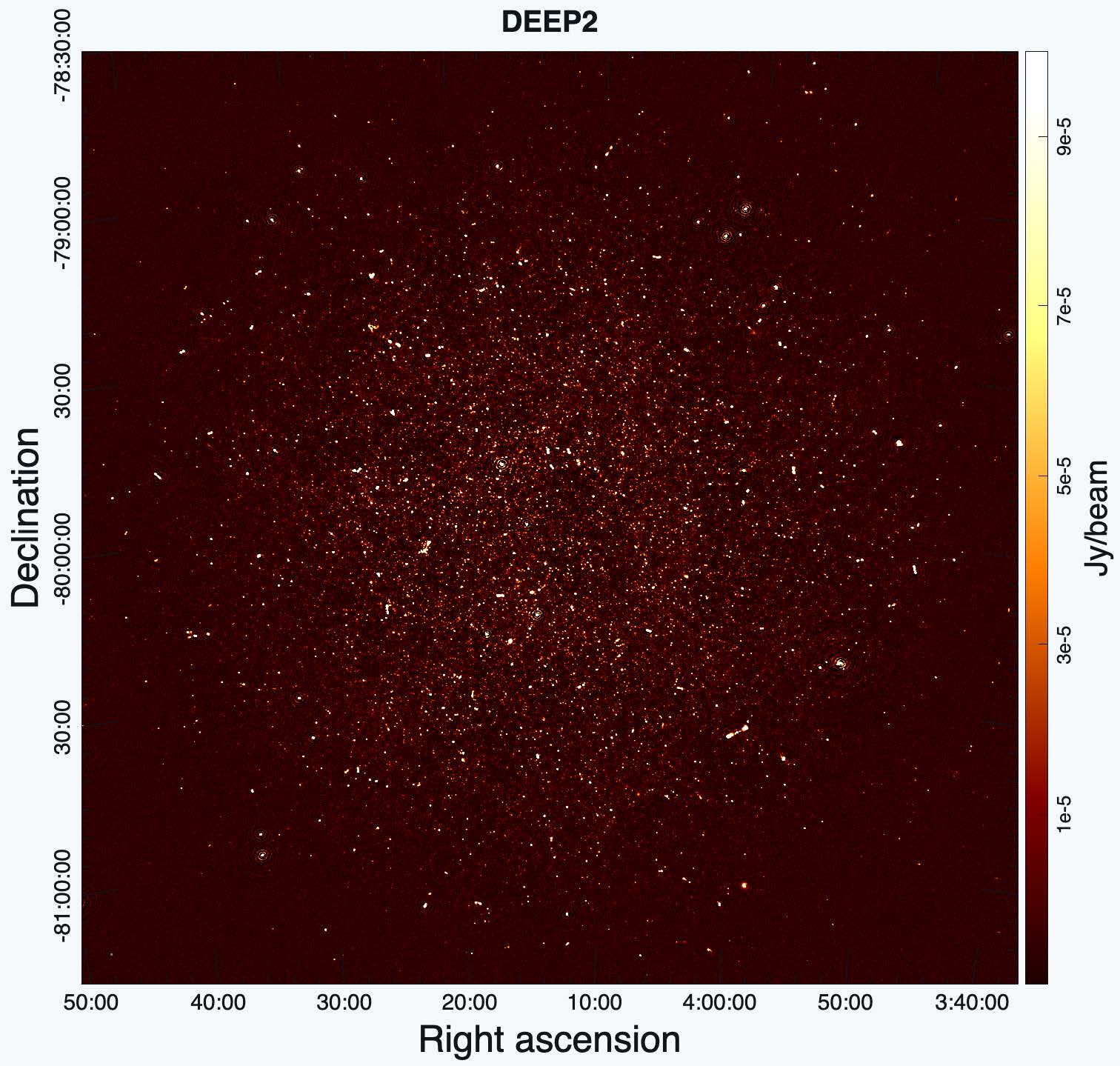
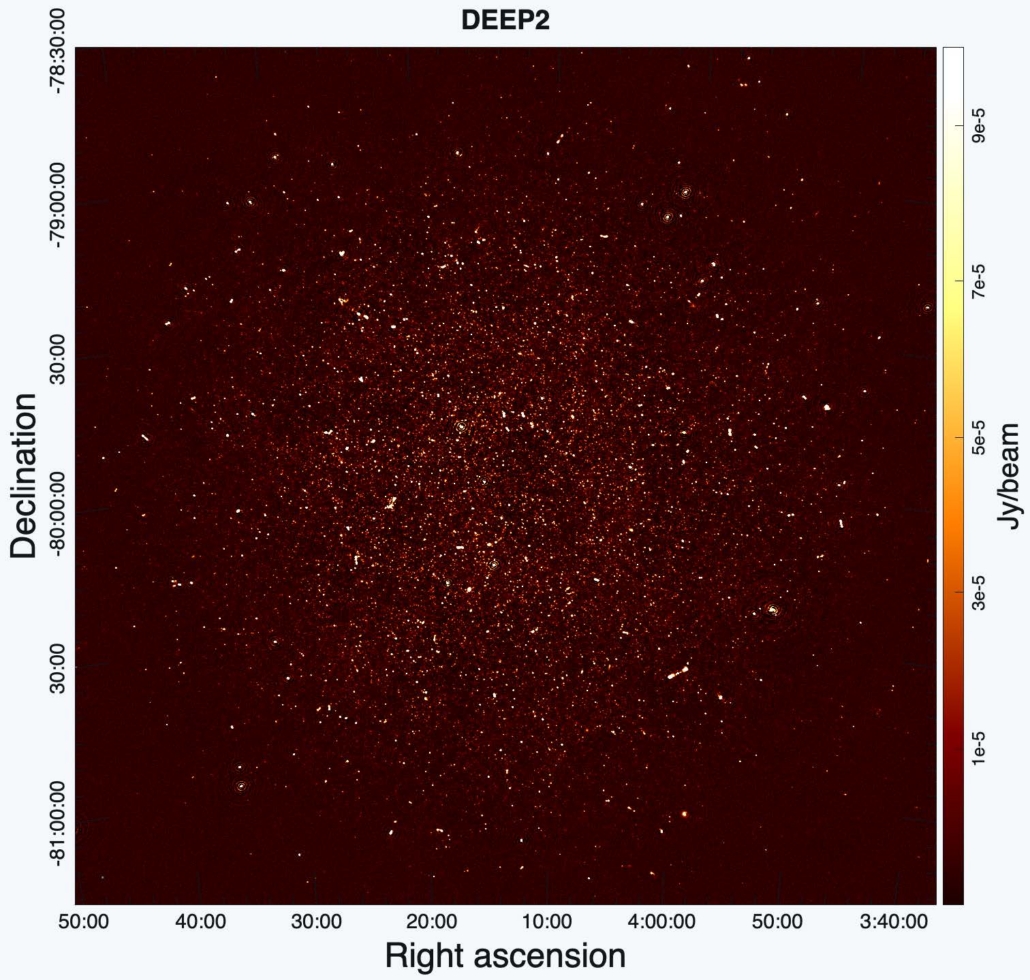
Figure 2: MeerKAT view of the observed sky field named DEEP2. This radio image shows the patch of sky observed with MeerKAT as part of the study. The bright points are thousands of radio-emitting galaxies and other compact sources, whose emission is much stronger than the faint hydrogen signal the team set out to measure. One of the major challenges of hydrogen intensity mapping is separating this extremely weak signal from much brighter foreground radio emission and unwanted interference. The hydrogen signal itself is not visible by eye in this image; it is extracted from the MeerKAT data using careful analysis designed to isolate the cosmic hydrogen emission. (Figure from Paul et al. 2026.)
