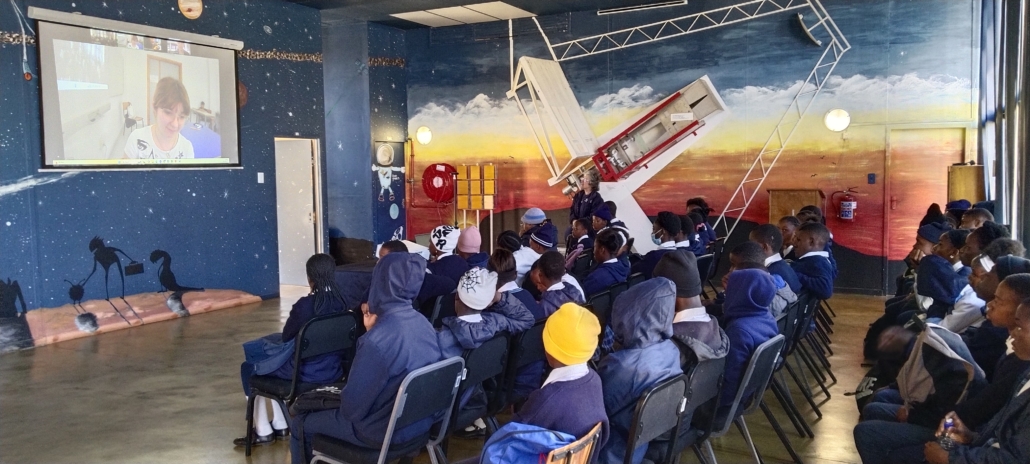

HartRAO hosts local school learners as part of the Sharing a Baseline Project
The Sharing a Baseline schools initiative was put into action earlier this year when the SARAO Science Engagement team hosted learners and educators from the Leokeng Secondary School in Bapong Village at HartRAO.
Taking place on Tuesday, 27 May 2025, the group of 59 Grade 8 learners and two educators arrived at HartRAO, excited for a day of learning about radio astronomy and taking part in related activities.
In 2024 the Sharing a Baseline Project connected observatories and their visitor facilities with young people – just as networks of telescopes and scientists are linked. The project aims to test ways of connecting schools with observatories, in the hope of expanding the programme in the future to the member countries of the SKA Observatory. The project explores ways of leveraging the global aspects of radio astronomy to increase science capital for young people aged 14-15 who have not yet chosen their path in life.
The project is supported by and reports to the SKA Observatory, the International Astronomical Union Office for Astronomy Outreach, and the Joint Institute for VLBI ERIC. It is led by Chalmers University of Technology, Sweden.
In 2024, Sharing a baseline connected classes in Finland, the Netherlands, Italy, Spain and Sweden. In 2025, the project connected schools and observatories in two countries, South Africa and Italy.
The visit to HartRAO was a follow-up session after an introductory engagement session at the school earlier in the year. The Leokeng Secondary School is a mathematics and science specialist school where every learner from Grade 8 to Grade 12 do these subject streams as part of the curriculum.
Science Engagement Coordinators Marion West and Simphiwe Madlanga, and intern Cassandra Mzola hosted the group and led them through the activities, which included:
- Whisper dishes – explaining how radio waves are focussed and amplified by parabolic dishes;
- Earth ball – explaining seasons and day and night;
- Analemmatic Sundial – explaining movement of the Sun in the sky throughout the year and using it to tell the time – the Earth Ball leading naturally into this;
- “Sharing a Baseline” activity – learners gathered in the Visitor’s Centre where they were able to link up over the internet with a group of learners in Sardinia (Italy) and share their experiences of visiting an observatory, in their respective countries, and of the activities they engaged in while at the observatory;
- “Walk-Out” of the Scale Model of the Solar System;
- Guided tour of Hart Instrumentation, including
- The 26 metre and 15 metre radio telescopes;
- Explanation of VLBI – combining telescopes on different continents;
- Explanation of Space Geodesy for measuring Earth parameters & determining radio telescope positions on Earth;
- Explanation of satellite laser ranging and links to finding our position on Earth (e.g. GPS); and
- Explanation of “All-Station” – linking all instrumentation on the Hart Site via laser beams.
Madlanga commented: “The event provided a valuable platform for engaging with high school learners and introducing them to careers in radio astronomy. We could consider follow-up engagements, such as school visits and periodic excursions by the school to the Hartebeesthoek Site for different learner cohorts to sustain learner interest and enrichment.”