
Rare ultra-magnetic star the key to solving a quantum cold case
Astronomers may have just confirmed one of the most bizarre aspects of quantum physics: that seemingly empty space can alter the behaviour of light.
This phenomenon, called ‘vacuum birefringence’, was first predicted 90 years ago by Werner Heisenberg, one of the founding fathers of quantum mechanics. He suggested that even a perfect vacuum should be teeming with ‘virtual particles’ that rapidly pop in and out of existence.
The astronomers, including Dr Fernando Camilo, the Chief Scientist from the National Research Foundation’s South African Radio Astronomy Observatory (SARAO), used the properties of a magnetar – a rare type of neutron star with the strongest magnetic fields in the universe – to study this quantum cold case.
Their observations uncovered what could be the first detection of vacuum birefringence taking place in the magnetar’s ultra-strong magnetic field and could open new pathways to exploring the quantum universe. The results were published today in Nature.
In the presence of an extremely powerful magnetic field, a sea of Heisenberg’s virtual particles is expected to refract light in specific ways, acting as a sort of prism, producing vacuum birefringence. Only magnetars have magnetic fields strong enough to make this quantum effect visible.
Dr Camilo is part of the international team that observed a magnetar known as 1E 1547.0–5408 (or 1E 1547 for short) in 2025 using NASA’s Imaging X-ray Polarimetry Explorer (IXPE), supported by the NICER (Neutron Star Interior Composition Explorer) X-ray telescope on the International Space Station and Murriyang, CSIRO’s Parkes radio telescope, owned and operated by Australia’s national science agency.
Dr Camilo discovered radio emission from the magnetar using the Parkes telescope in 2007, determining that it was rotating once every 2 seconds. His team have been studying this remarkable object ever since.
“At the time 1E 1547 was only the second magnetar in the Milky Way known to emit radio waves, and we were confident that regular monitoring would unveil interesting behaviour,” Dr Camilo said. “However we could never have imagined that 20 years later it would contribute to investigating a fundamental, and particularly quirky, prediction of quantum mechanics.”
Despite being predicted back in the 1930s, a concrete detection of vacuum birefringence has so far remained elusive.
Team member Dr Marcus Lower from Swinburne University performed the recent Murriyang observations and subsequent analysis of the radio data that has contributed in key fashion to what could be the first direct detection of this once-theoretical quantum effect.
“Detecting vacuum birefringence requires a magnetic field that is over 100 million times stronger than any we’ve ever made on Earth. Thankfully, nature has provided us with magnetars, which are the perfect cosmic laboratories to go looking for this effect,” Dr Lower said.
By carefully tracking how the direction of the radio waves detected from the magnetar (their ‘polarisation state’) varies as it rotates, the team found that the magnetic and rotational axes of 1E 1547 are nearly aligned and are viewed almost pole-on. This combination of magnetic and viewing geometry makes 1E 1547 ideal to look for vacuum birefringence.
The team then identified two telltale signs that vacuum birefringence is acting around the magnetar: they found that X-rays produced by the magnetar and picked up by IXPE had extremely high levels of polarisation – nearly three times greater than seen in similar sources and also larger than predicted by standard models for emission from the surface of neutron stars, indicating that another effect must be boosting the polarisation – and that the polarisation direction was locked to 1E 1547’s magnetic field in the same way as the radio waves.
“Because of the magnetic field’s strength, Heisenberg’s virtual particles become aligned with the direction the field is pointing,” Dr Lower said.
This was the first-ever coordinated radio and X-ray polarisation measurement of a magnetar, making use of the IXPE mission’s essential ability to measure X-ray polarisation and the constraints on the geometry of the magnetic field surrounding the magnetar provided by the Parkes radio observations.
“This result truly highlights the interdisciplinary power of the field of astrophysics,” said Rachael Stewart, a PhD candidate at George Washington University and lead author of the study. “The information we obtained from looking at this distant star core also gives us clues about the nature of the fabric of reality as we know it, and I find that to be incredible.”
This finding could soon be confirmed with additional data alongside improved computer simulations to better differentiate the vacuum birefringence signal from other processes occurring around magnetars. More such studies also pave the way for a fuller understanding of quantum electrodynamics in some of the most extreme environments in our universe.
The paper titled “Vacuum birefringence and the polarized X-ray emission from a radio magnetar” has been published in Nature.
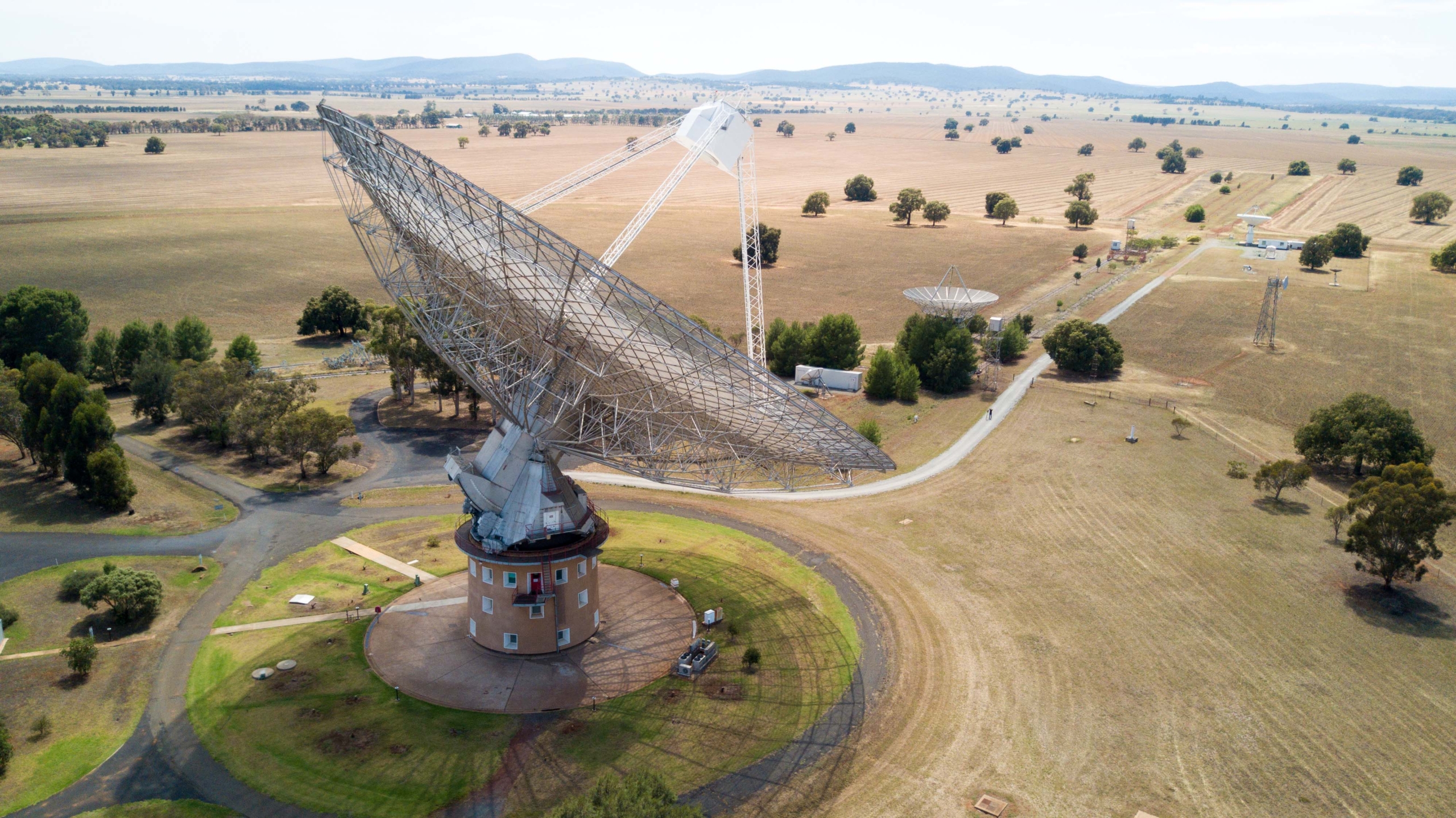
The Parkes Observatory, with Murriyang, the 64-metre CSIRO’s Parkes radio telescope in the foreground. Credit: CSIRO.
Fast facts
- Magnetars are a special class of neutron stars with ultra-strong magnetic fields, the strongest of any object in the observable universe, around 100 billion times stronger than the strongest permanent magnets ever built on Earth. These super magnetic neutron stars – only 30 of which are known – offer glimpses into the physics of extreme environments that cannot be found anywhere else. Most magnetars have been discovered through their X-ray emission, but a handful are also known to emit radio waves.
- Neutron stars are the leftover cores of massive stars, typically formed at the end of their life cycles in supernova explosions, that possess more mass than the Sun, condensed down to the size of a city, making them natural laboratories for studying extreme physics. Some 3000 neutron stars have been discovered to date, mostly through their radio emission, although a substantial fraction are known to also emit high-energy X-rays and gamma-rays.
- The IXPE mission, which continues to provide unprecedented data enabling groundbreaking discoveries about celestial objects across the universe, is a joint NASA and Italian Space Agency mission with partners and science collaborators in 12 countries. Learn more about IXPE’s ongoing mission at https://science.nasa.gov/mission/ixpe.
- Murriyang, the 64-metre Parkes radio telescope, is located near the town of Parkes in Australia and is one of the telescopes comprising CSIRO’s Australia Telescope National Facility. It has been in operation since 1961 and continues to be productively used by astronomers from around the world thanks to regular upgrades. Learn more about the Parkes Observatory at https://www.parkes.atnf.csiro.au.
- The South African Radio Astronomy Observatory (SARAO), a facility of the National Research Foundation, is responsible for managing all radio astronomy initiatives and facilities in South Africa, including the MeerKAT radio telescope in the Karoo, and the geodesy and VLBI activities at the HartRAO facility. SARAO also coordinates the African Very Long Baseline Interferometry Network (AVN) for the eight SKA partner countries in Africa, as well as South Africa’s contribution to the infrastructure and engineering planning for the SKA-Mid radio telescope. To maximise the return on South Africa’s investment in radio astronomy, SARAO is managing programmes to create capacity in radio astronomy science and engineering research, and the technical capacity required to support site operations. Learn more about SARAO at https://www.sarao.ac.za.
