
MeerKAT maps hydrogen across large cosmological scales
The MeerKLASS Collaboration reports their first measurement of the large-scale clustering of cosmic hydrogen, advancing a technique that could transform how cosmologists chart the Universe.
After a decade of preparation and work, an international group of researchers working with data from the South African MeerKAT radio telescope on the MeerKAT Large Area Synoptic Survey, known as MeerKLASS, has directly measured how neutral hydrogen ‘clumps’ in the distant Universe, demonstrating that its distribution follows the structure of the cosmic web. Mapping this structure on the largest scales of the Universe has been a goal of cosmology for decades. The research has just been accepted for publication in the Monthly Notices of the Royal Astronomical Society.
Schematic view of the measurement. The dishes of the MeerKAT telescope – pictured at left – map the cosmic structure via emission from neutral hydrogen atomic gas (HI). Within the analysis, the science team creates 4 independent datasets to minimize observational effects and contaminations. These datasets are used to measure the clustering of the structure as a function of scale via the so-called power spectrum – pictured on the right with an indication of the statistical strength of the measurement, a so-called signal-to-noise ratio of 6.2.
This has been possible via a technique known as 21-cm intensity mapping, which combines hydrogen emission from many galaxies within large patches of sky, capturing the collective pattern even when individual galaxies cannot be distinguished. This technique provides the ability to build a huge 3D map of the Universe.
For this detection, the team analysed MeerKAT observations across approximately 250 square degrees of sky – roughly the area of 1250 full moons. The observed signal originated about 4.5 billion years ago, when the Universe was a little older than 9 billion years. Extracting it required overcoming extremely challenging problems such as removing astrophysical ‘foreground’ emission around 10,000 times stronger than the hydrogen signal itself; finding it is a little like trying to make out a whispered conversation from the front row of a roaring rock concert.
The measurement relied on a completely new observing mode for MeerKAT. Rather than combining its 64 dishes into a single interferometer, they operated each dish as an independent telescope — trading sharp angular resolution for very high survey speed. This produced many independent maps, from different dishes and observing times, that could be cross-compared: real cosmic structure recurs across them, while instrumental effects that differ are suppressed. Combining these maps was crucial to beating down systematics and confirming a signal standing more than six times above the statistical noise.
“This is a milestone in establishing 21-cm intensity mapping as a novel tool for cosmology”, said Prof. Mário Santos, Principal Investigator of the MeerKLASS survey at the University of the Western Cape. “This measurement took a decade of patient work by researchers spread across seven countries and three continents — and many of them are early-career scientists who have spent their whole career on this project. Such an ambitious result requires sustained and genuine teamwork from many people. And none of it would exist without the South African Radio Astronomy Observatory, which built and operates MeerKAT and helped sort out the many challenges with this survey along the way. It is a reminder that science at this level is a large collaborative effort.”
This observation is only possible because of the excellent sensitivity and, crucially, stability of the MeerKAT telescope, the culmination of world-class design and engineering from SARAO, a National Facility of South Africa’s National Research Foundation. MeerKAT’s achievement provides a foundation for the next stage where a much larger area of the sky will be surveyed with similar techniques. As a precursor to the SKA Observatory, MeerKAT is demonstrating how repeated radio observations can enable reliable measurements of the Universe’s large-scale structure that will help cosmologists understand how the Universe evolved, with the ultimate aim of understanding the physical laws that govern it.
Since 2023, the MeerKLASS Collaboration has continued collecting data at lower radio frequencies, corresponding to HI emission originating from even more distant past times. Eventually MeerKLASS expects to map the Universe across a volume over a thousand times larger than what was used for this detection. This will allow the team to probe the Universe’s large-scale structure over ever larger swathes of its history and eventually, investigate the growth of cosmic structure and the expansion of the Universe, helping to test models of gravity and dark energy.
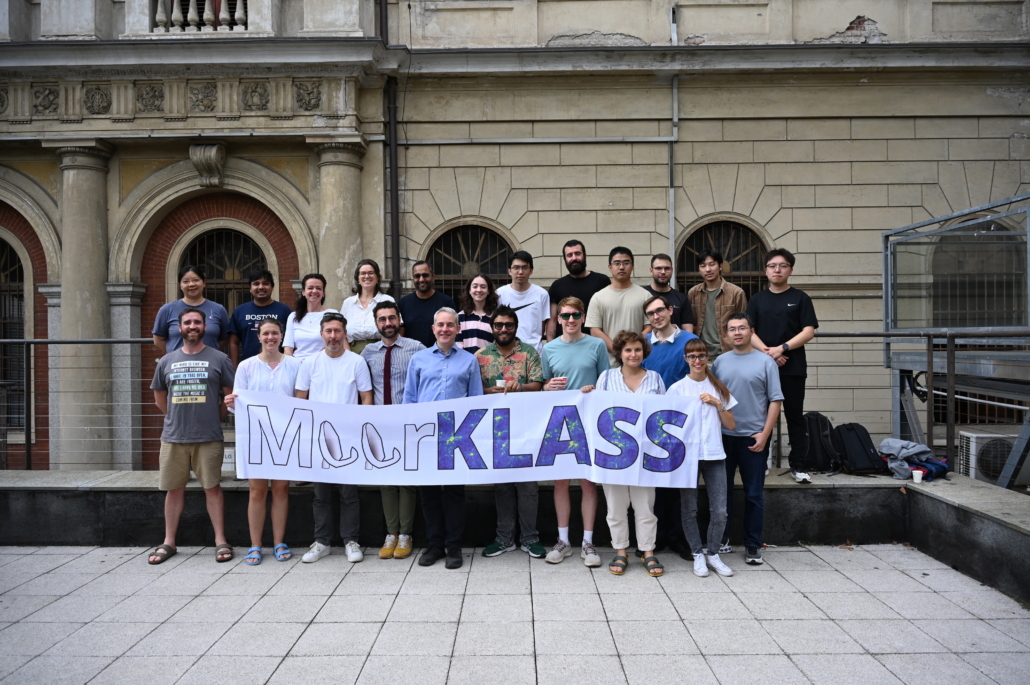
Members of the MeerKLASS collaboration at their bi-annual meeting ’Busy Week’ hosted at the University of Torino in September 2025. A list of MeeerKLASS members can be found at https://meerklass.org/team.html
Research:
https://arxiv.org/abs/2610.12158 – Accepted for publication by the Monthly Notices of the Royal Astronomical Society on October 1, 2026.
