
South Africa’s MeerKAT combines with NASA’s Webb to pinpoint the most distant cosmic Fast Radio Burst
Record breaker dates back to just 3 billion years after the big bang.
In research published today in the journal Science, astronomers show that the most distant fast radio burst (FRB) identified to date originated from a surprisingly small and young galaxy at a time when the universe was only a quarter of its current age. While the origin of these cosmic beacons of radio waves remains uncertain, the new results indicate that this FRB was likely emitted by a young neutron star known as a magnetar.
The combined power of a new generation of ultra-sensitive radio telescopes such as MeerKAT and the upcoming SKA and the unique capabilities of the James Webb Space Telescope promises more such discoveries to illuminate a poorly understood era of distant cosmic time.
Astronomers using the MeerKAT radio telescope in South Africa and NASA’s James Webb Space Telescope have discovered and precisely localized the most distant fast radio burst (FRB) ever recorded, a powerful flash of radio waves lasting only a few milliseconds that travelled for more than 10 billion years across the cosmos before reaching Earth.
FRBs are enigmatic objects whose brief radio flashes are detectable half-way across the universe. First identified in 2007, their origins remain uncertain, particularly since most are seen only once.
The research reported today started with the discovery by the MeerTRAP team of a radio burst on March 4, 2024, leading to its designation as FRB 20240304B. The MeerKAT data precisely localized the FRB and suggested that it was extremely distant, but to measure the distance accurately astronomers would need to study its host galaxy. The galaxy, however, was invisible to the world’s largest ground-based telescopes, requiring instead the unique capabilities of the Webb space telescope. The results were remarkable.
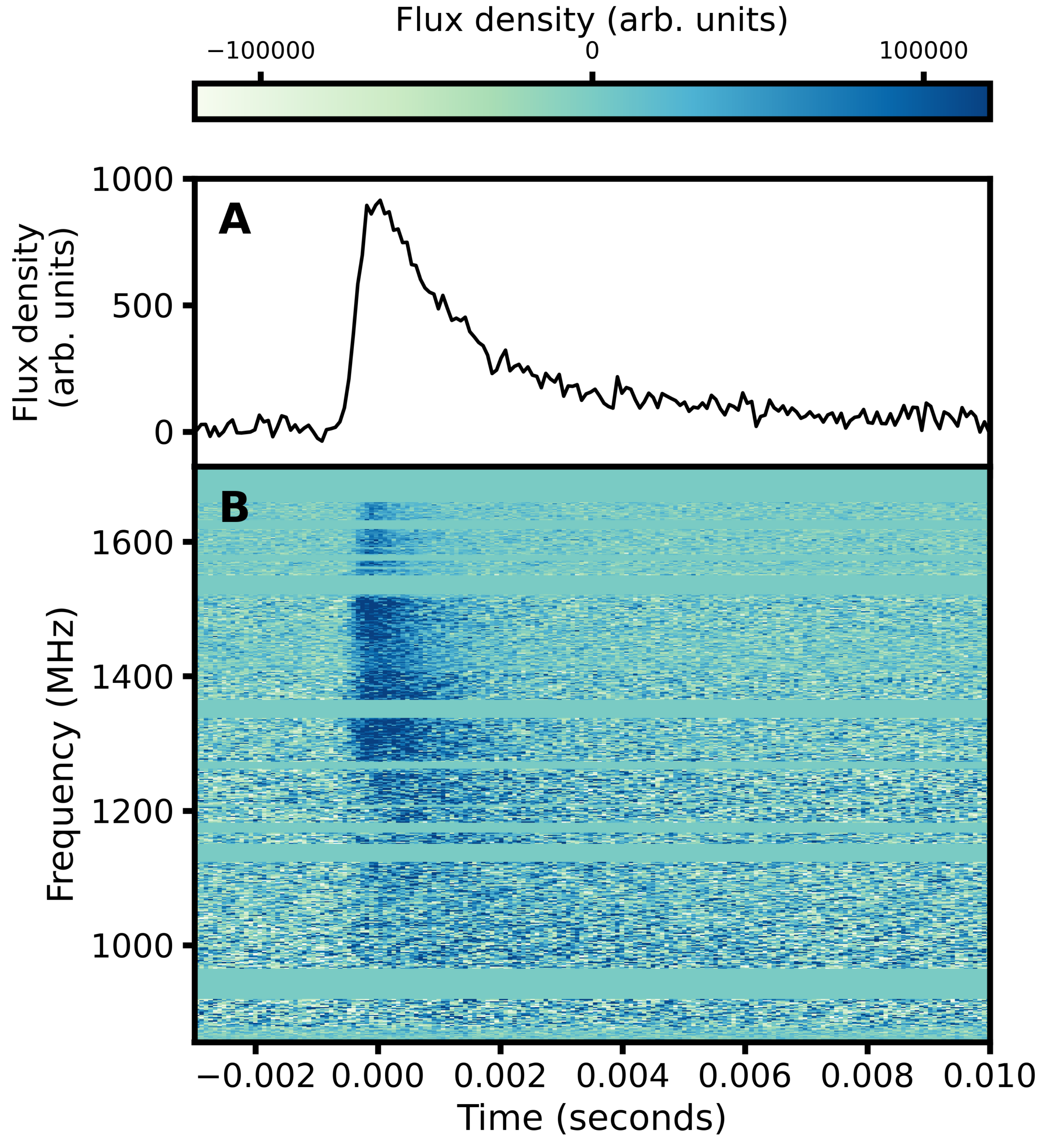
MeerKAT discovery of the fast radio burst FRB 20240304B at radio frequencies of approximately 900–1700 megahertz. The intrinsic emitted signal lasts for only approximately 1 millisecond but as it propagates across the universe it is broadened to several milliseconds by interaction with the intervening matter through which it passes. It therefore also serves as a beacon to explore structures across the cosmos that are otherwise difficult to observe directly. Credits: Manisha Caleb et al. (Science 2026).
Using its infrared instrumentation, Webb detected a galaxy at the right spot and measured a redshift of 2.148, indicating the burst originated when the universe was only 3 billion years old. This makes it the most distant FRB yet detected, more than doubling the previous distance record. In addition, the team found that the host galaxy of FRB 20240304B was atypical for an FRB host. Most FRB hosts are massive star-forming galaxies, but the galaxy they found was 1000 times less massive than expected.
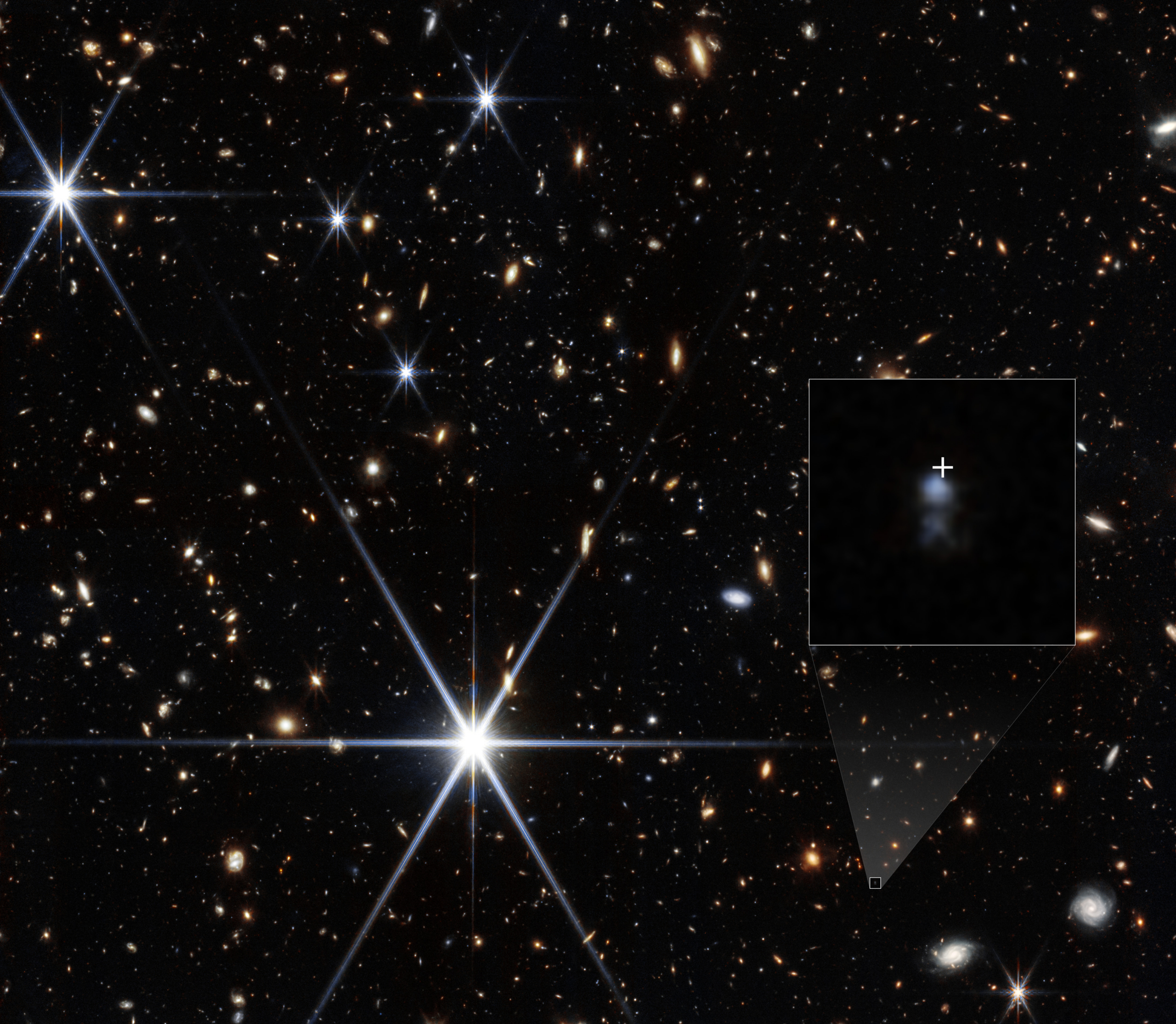
NASA’s James Webb Space Telescope’s NIRCam (Near-Infrared Camera) was able to detect the host galaxy of the fast radio burst FRB 20240304B, whose location is shown in the zoomed-in inset by the white cross. It is a small dwarf galaxy actively forming stars. Credits: Image NASA, ESA, CSA, STScI, Themiya Nanayakkara (USYD). Image Processing Joseph DePasquale (STScI).
“We thought it would be a big, nicely formed galaxy with lots of stars, and instead it was a little dwarf galaxy, although it was actively forming stars,” said Manisha Caleb of the University of Sydney, lead author of the study.
The galaxy is observed at “cosmic noon”, when star formation in the universe was at its peak, and it appears that the majority of its stars may have formed within just 30 million years. In turn this implies that one of the models for the formation of FRBs – that they may originate in the merger of neutron stars – is not applicable in this instance since binary neutron stars typically take at least a billion years to merge. Rather, it is more likely that this FRB resulted from an energetic event such as a starquake in a young magnetar – neutron stars with the strongest magnetic fields known in the universe – born in the supernova collapse of a young massive star.
“What is particularly exciting about our result is that we’ve now demonstrated that we can identify and study an FRB from when the universe was young,” said Caleb.
According to Ben Stappers from the University of Manchester, co-author of the study and Principal Investigator of the MeerTRAP project on MeerKAT, “the next step is to push this frontier further and see how close we can get to the first generations of stars.”
With its unparalleled combination of sensitivity to faint radio signals and ability to localize them precisely, MeerKAT may be able to detect and localize several FRBs per year at a redshift greater than 1, at a time more than halfway back to the start of the universe. Within a few years this discovery space should expand: the SKA-Mid telescope of the SKA Observatory, currently being built in South Africa and into which MeerKAT will be incorporated, will detect larger numbers of more distant FRBs, while Webb will characterize their host galaxies.
“It is gratifying to see MeerKAT continuing to be used for ground-breaking discoveries such as this one, and we congratulate the researchers for such beautiful work”, said Adrian Tiplady, Acting Managing Director of the National Research Foundation’s South African Radio Astronomy Observatory (SARAO) that built and operates MeerKAT. “We look forward to the coming years of further exciting FRB discoveries, first with MeerKAT and then SKA”.

Artwork conveying the journey of the fast radio burst FRB 20240304B signal across cosmic distances, combined with the radio and infrared telescopes used to study it. The mountain landscape at the bottom is based on a photograph of the landscape surrounding the MeerKAT telescope in the Northern Cape province of South Africa. The background incorporates the James Webb Space Telescope (JWST) NIRCam image of the field that contains the FRB’s host galaxy, together with a stylized representation of the JWST primary mirror. The concentric rings surrounding the FRB origin represent the propagation of the radio signal through the expanding universe and the associated cosmological redshifting of its frequencies. The progression from blue towards red therefore has a physical meaning. At the center of the artwork, the FRB itself is depicted as a bright burst propagating towards MeerKAT (with two of its 64 dishes represented), visually connecting the distant cosmic event with the radio telescope that detected it. Credits: Artwork Carl Knox, OzGrav, Swinburne University of Technology. Background Image NASA, ESA, CSA, STScI, Themiya Nanayakkara (USYD). Image Processing Joseph DePasquale (STScI).
ENQUIRIES
For media interviews: Angus Flowers – Science Communication Officer
South African Radio Astronomy Observatory (SARAO)
Email: aflowers@sarao.ac.za
RESEARCH
Caleb, M. et al. ‘A fast radio burst at redshift 2, three billion years after the Big Bang’ (Science 2026). http://www.science.org/doi/10.1126/science.adz2675
THE TELESCOPES
MeerKAT consists of 64 dishes operating at radio frequencies of 0.6–3.5 GHz, each 13.5 meters in diameter, spread over a diameter of 8 km in the Karoo region of the Northern Cape province of South Africa. The MeerKAT telescope is operated by the South African Radio Astronomy Observatory (SARAO), which is a facility of the National Research Foundation, an agency of the Department of Science, Technology and Innovation.
The James Webb Space Telescope is the world’s premier space science observatory. Webb is solving mysteries in our solar system, looking beyond to distant worlds around other stars, and probing the mysterious structures and origins of our universe and our place in it. Webb is an international program led by NASA with its partners, ESA (European Space Agency) and CSA (Canadian Space Agency).
