

SARAO’s Big Data Africa School focusses on Earth Observation in equipping African students with data science skills needed for a changing climate and environment

Group photo of the Big Data Africa School 2025 participants
The South African Radio Astronomy Observatory (SARAO) successfully hosted its 5th Big Data Africa School at the Sun Square Hotel in Cape Town from 10 to 15 March 2025. The theme of the 5th Big Data Africa School focussed on the application of machine and deep learning techniques to Earth observation data (including satellite, aerial and ground station data), in addressing African challenges brought about by a change in weather, climate and environment.
It was the first time that a Big Data Africa School was dedicated to the topic of Earth observation, with students receiving hands-on training on datasets that demonstrate various African challenges facing different regions of the continent. This year’s school was funded by the UK’s International Science Partnerships fund under the Development in Africa with Radio Astronomy (DARA) project.
A total of 26 students participated in the 5th Big Data Africa School with half of the participants being South African, and the remaining participants having nationality from one of seven African partner countries of the Square Kilometre Array (SKA) – Botswana, Ghana, Kenya, Madagascar, Mozambique, Namibia and Zambia. Most students participating in the school were undertaking a Masters degree in science or engineering. Students had various educational backgrounds ranging from physics, computer science / engineering, Earth observation and remote sensing, data science, applied mathematics or statistics.
Former DARA Big Data student, Dr Edward Salakpi, served as the technical lead for the 5th Big Data Africa School having carried out his doctoral research using data-intensive techniques on satellite Earth observation (remote sensing) datasets. Dr Salakpi carried out his postdoctoral training at the University of Stirling, a partner in the school, before taking up a role of remote sensing scientist with private company, Okala, in Stirling, UK. As the technical lead for the school, Dr Salakpi was responsible for managing all technical aspects related to the projects offered as part of the Big Data Africa school.
This year’s school offered five projects in Earth observation for the students to undertake, which included accurately mapping banana plantations in Africa to enable near real-time monitoring for checking crop health, accurately mapping flood extents to enable rapid relief efforts, monitoring changes in urban areas (such as Cape Town) to support urban planning / development, monitoring of protected areas such as peatlands and mangroves, and the benchmarking of deep learning weather forecasting models across several data-scarce regions in Africa such as the Sahel, Horn of Africa and Southern Africa. The latter project was offered by partner and data scientist, Dr Sabrina Amrouche, who is part of the African-focussed community of geospatial artificial intelligence (AI), GeoAI-Africa, and a co-founder of the startup AfriClimate AI. The projects for this year’s school were hosted on partner Digital Earth Africa’s Sandbox Cloud platform, who provided the compute, data storage and digital notebooks needed for students to carry out the projects.
One of the highlights of this year’s school was a visit to the Amazon Web Services (AWS) Skills centre located in Cape Town, where students were exposed to various applications of the AWS Cloud and accessing Cloud-related courses for expanding their skills in using digital technologies such as the Cloud.
Another key milestone of this year’s school was the achievement of gender parity for a second consecutive school with just over fifty percent of participants being women. The previous Big Data Africa School in 2023 attained an exceptional female participation level with over seventy percent participation of women in this school.
Dr Bonita de Swardt, SARAO Programme Manager: Strategic Partnerships for Human Capital Development, as well as main organiser of the Big Data Africa Schools comments that, “It is wonderful to see that we are finally achieving equal participation by women and men in the Big Data Africa Schools.” She further adds that, “We have come a long way in trying to implement recommendations put forward as part of SARAO’s Women in Data Science Report (2021) in increasing the participation of young African women in our training events. It is encouraging to see that we are finally bridging the gender gap with more young women taking up training opportunities and having the potential to become leaders in these technological emerging fields.”
Students worked on their allocated project within a group setting under the guidance of mentors during the week of training. The groups presented the results for their projects to a panel of judges on the final day of the school. Individuals forming part of this year’s judging panel included: Dr Kenneth Mubea (Capacity Development Lead, Digital Earth Africa), Dr Sally Macfarlane (Associate Director of Development & Outreach, IDIA), Phila Sibandze (Lecturer, Department of GIS & Remote Sensing, University of Fort Hare), Carla Mitchell (Africa Programme Manager, SARAO), Dr Landman Bester (Senior Scientific Software Developer, SARAO), Cecil Masoka (Director: Europe and Gulf States, Department of Science, Technology and Innovation), Neil Lategan (Senior Manager: Cloud, Deloitte) and Mark Johnson (Principal IP Officer, SARAO).
Further remarks on the 5th Big Data Africa School were made by the main partners during the prize-giving and closing of this year’s school:
“Powered by partnerships, the 5th Big Data Africa School presented an opportunity for a gathering of pan African young innovations, who were provided an opportunity to harness big data platforms such as Digital Earth Africa to solve real world problems. Their innovations showed how the young people are agile in developing local solutions that will help Africa achieve the African Union Agenda 2063, the Africa we want,” said Mubea.
Mitchell commented: “I am impressed with the enthusiasm and ability of the students selected and, even though the workshop was out of their sphere of capability, they learned quickly and adapted and it is a wonderful example of people from different areas of Africa coming together to solve problems collaboratively. Again we see this workshop with wonderful innovation and problem solving potential for the future as a result of their time and this week.”
Masoka added: “The mentoring provided by South Africa and African partners exposed students to skills that are essential for the digital world of the future. The DSTI is continuing to build big data skills in analytics and to support decision support in an effort to help South Africa and African countries to use digital skills to solve African problems. The projects presented by the students at the Big Data African school have huge potential to support agri-businesses, assist SMMEs and even corporates in defining new markets and products. It is because of this potential that the DSTI continues to support the Big Data Africa School and looks forward to building partnerships with industry players like AWS and others.”
Feedback from students on the 5th Big Data Africa School included:
Baboloki Chipo Mazhani – MSc Student, Botswana
“As a physics major from Botswana who discovered a passion for coding and technology later in life, I’ve often found it difficult to connect with people on a similar path. However, this program and the community it provided have been incredibly rewarding. Learning alongside peers who share the same curiosity and ambition has been a highlight. The mentors’ stories reassured me that even when the learning path feels isolating, persistence and dedication will lead to success.
The program has also solidified my decision to pursue a career in data science. Seeing firsthand the incredible things that can be done with data has sparked my interest in exploring PhD research topics that integrate machine learning. I now feel much more confident in taking the next steps toward that goal. Additionally, the hands-on experience with satellite data has given me a strong foundation, and if the opportunity arises to contribute to projects like Botsat-1, I’ll owe a great deal of credit to this experience. While I am still in the process of self-learning software engineering, I’m eager to integrate the machine learning and deep learning concepts I gained at the school into my learning journey.”
Philippe Manjakasoa Randriantsoa – PhD student, Madagascar
“The 5th Big Data Africa School was an incredible experience, and I truly appreciate the opportunity to be part of such a well-structured and insightful program. It provided a valuable learning experience and the chance to engage with experts and peers in the field. The knowledge and skills I gained, particularly in data analysis and machine learning applications, will greatly benefit my research and career development.”
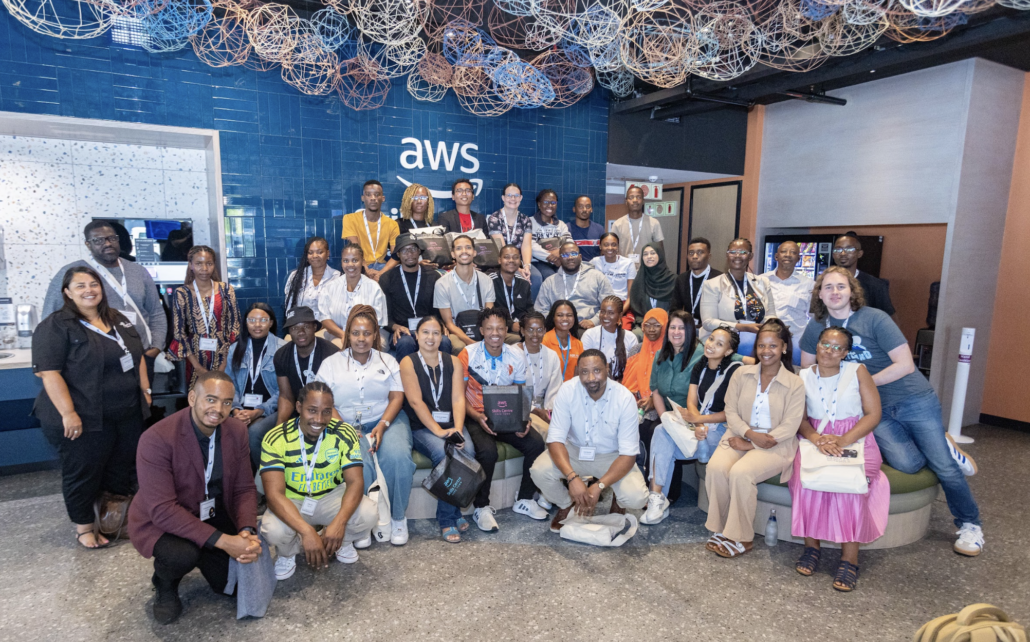
Group photo of the Big Data Africa School 2025 participants during their visit to Amozon Web Services Skills Centre in Cape Town
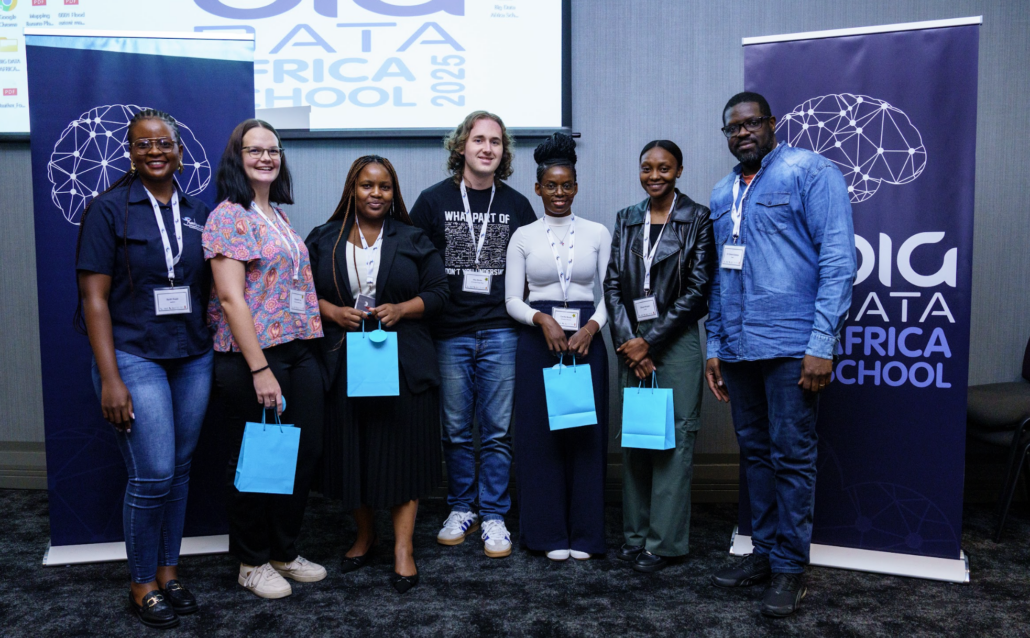
The first prize for students was won by the students working on a Banana Plantations in Africa project
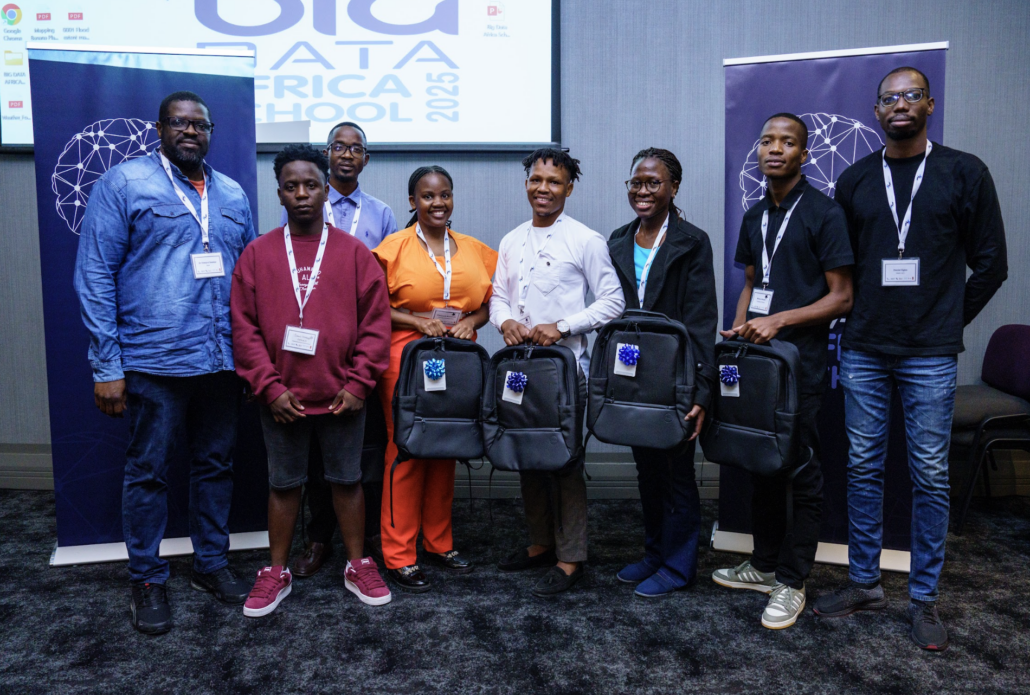
The runner up group prize for students was won by the students working on an Urban Development project

The panel of judges for the group project presentations, from left to right: Cecil Masoka (Director: Europe and Gulf States, Department of Science, Technology and Innovation), Dr Sally Macfarlane (Associate Director of Development & Outreach, IDIA), Neil Lategan (Senior Manager: Cloud, Deloitte), Dr Kenneth Mubea (Capacity Development Lead, Digital Earth Africa), Carla Mitchell (Africa Programme Manager, SARAO), Dr Landman Bester (Senior Scientific Software Developer, SARAO), Phila Sibandze (Lecturer, Department of GIS & Remote Sensing, University of Fort Hare), and Mark Johnson (Principal IP Officer, SARAO)
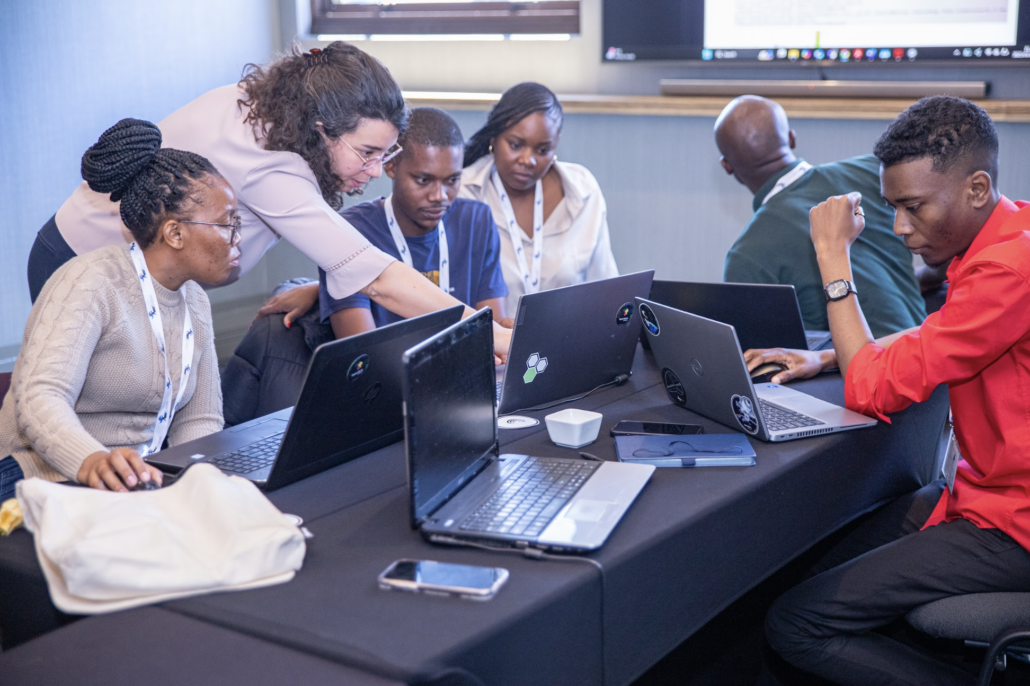
Students working in a group with their mentor at the Big Data Africa School 2025
